1234
5678
// welcome
Detroit
Developers
Developers
monthly meetup
detroitdevelopers.com
⑂ main
● welcome.md
1 / 42
Detroit, MI
1234
5678
// thank you to our sponsor

RIVET
Construction Labor Planning for increased Productivity
We're hiring →
rivet.work/careers
rivet.work/careers
⑂ main
● sponsors.md
2 / 42
rivet.work
1234
5678
// your organizers
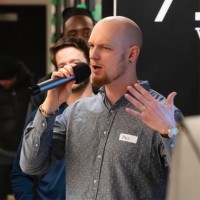
Phil Borel
Organizer
philborel.com
detroitdevelopers.com

Louis Gelinas
Organizer
linkedin.com/in/louis-gelinas
⑂ main
● organizers.md
3 / 42
Detroit, MI
1234
5678
// intro
Agentic Software
Development
Development
Advanced Practitioner's Guide
Phil Borel · RIVET · Detroit Developers · April 2026
detroitdevelopers.com/slides/agentic-advanced-practitioners-guide-60min
⑂ main
● title.md
4 / 42
Detroit, MI
1234
5678
// act I
Act I
The Goal
3x Product Development Velocity
⑂ main
● act-i.md
5 / 42
Detroit, MI
1234
5678
// the goal that kicked it all off
February 2026 · All-Hands
3x Product
Development Velocity
Development Velocity
BHAG - Big Hairy Audacious Goal
by Q1 2027
⑂ main
● bhag.md
6 / 42
Detroit, MI
1234
5678
// how we got started
The BHAG gave us an excuse to take Agentic Dev seriously
- Learned - read papers & blog posts; watched talks; listened to podcasts
- Convened - started a weekly AI Roundtable where devs share what's working & what's not
- Experimented - every engineer using Claude Code; open-door policy on tools & workflows; no caps on skills, CLAUDE.md updates, etc
- Planned - created quarterly goals tied to outcomes to track progress against the BHAG
- High-volume learning environment, not a slow-roll adoption process
⑂ main
● bhag-response.md
7 / 42
Detroit, MI
1234
5678
// what does 3x mean?
What does 3x even mean?
- Vibes - execs, CS, sales, product feel like we shipped 3x the value
- Metrics - DORA metrics (CFR, MTTR, DF), 3x PRs, bugs / time
- Outcomes - 3x projects shipped; users get more value more quickly
- All three matter. None is sufficient alone.
- Risk: 10x some metrics while seeing modest gains on outcomes
⑂ main
● what-is-3x.md
8 / 42
Detroit, MI
1234
5678
// work in progress
A working case study.
Not a success story.
Yet.
Not a success story.
Yet.
Progress from Feb -> Apr:
- ~2x velocity increase vs last yearmuch of the acceleration came from process changes, code refactors & quality initiatives - not from specific tools or Agentic Dev
- Zero P0 incidents - down from ~one per sprint
⑂ main
● work-in-progress.md
9 / 42
Detroit, MI
1234
5678
// act I take-away
Act I take-away:
Set a Goal
Set a Goal
Vibes · Metrics · Outcomes
⑂ main
● act-i-takeaway.md
10 / 42
Detroit, MI
1234
5678
// act II
Act II
AI is an
Amplifier
Amplifier
y = mx + b || Outputs are the result of inputs
⑂ main
● act-ii.md
11 / 42
Detroit, MI
1234
5678
// the research
AI is an amplifier.
- DORA 2025 (5,000 professionals): high-performing orgs see 50% fewer customer incidents. Struggling orgs: 2× more.
- Carnegie Mellon 2026 (807 open source repos): 281% increase in lines added month one. Month two: velocity gone, back to baseline. Complexity +41% permanently.
- In the wild (Amazon retail): spike in outages → senior sign-off mandate.
- "AI is moving organizations in different directions." - Laura Tacho, DX
⑂ main
● amplifier.md
12 / 42
Detroit, MI
1234
5678
// what AI amplifies
What does AI amplify?
- Good architecture → maintainable code
- Bad architecture → friction increases with every new feature
- Good specs → accurate, testable implementations
- Vague specs → confidently wrong code that passes tests you don't understand
- Consistent patterns → idiomatic output on the first try
- n divergent patterns → tech debt increases agentically
⑂ main
● what-it-amplifies.md
13 / 42
Detroit, MI
1234
5678
// the implication
Best practices matter more with AI, not less.
⑂ main
● implication.md
14 / 42
Detroit, MI
1234
5678
// the quality upside
Agentic Dev has unlocked a renewed focus on quality
⑂ main
● quality-focus.md
15 / 42
Detroit, MI
1234
5678
// rules → refactors
Rules → Refactors
Bot see, bot do
⑂ main
● rules-to-refactors.md
16 / 42
Detroit, MI
1234
5678
// keeping quality in check
More PRs, same (or better) quality
- 1. Architectural review - human, before code is written
- 2. Automated review - /review-pr skill, SonarCloud, Copilot review, linting, tests (all in CI)
- 3. Human code review + manual QA - focused on the feature, based on test steps in the PR
- 4. Full-app UAT/regression - end of every sprint (working toward replacing with Playwright)
- Result: 2 P0s this year despite ~2x PR throughput (vs 8 previously)
⑂ main
● review.md
17 / 42
Detroit, MI
1234
5678
// act II take-away
Act II take-away:
Focus on the Fundamentals
Focus on the Fundamentals
Leverage AI to improve your codebase
⑂ main
● act-ii-takeaway.md
18 / 42
Detroit, MI
1234
5678
// act III
Act III
Agentic Dev
Maturity
Maturity
Prompt · Context · Harness
⑂ main
● act-iii.md
19 / 42
Detroit, MI
1234
5678
// the three layers
Each outer layer contains and depends on the inner ones
⑂ main
● layers.md
20 / 42
Detroit, MI
1234
5678
// layer 1: prompt engineering
Prompt Engineering
- Telling an agent what to do effectively
- Written prompts, rules, skills
- In practice: almost entirely markdown optimization
- Tight feedback loop - edit a file, run a session, see what changed
- Ceiling: ~+1x velocity
- systems to measure & optimize prompt effectiveness (Chip Huyen)
⑂ main
● prompt-engineering.md
21 / 42
Detroit, MI
1234
5678
// layer 2: context engineering
Context Engineering
- Managing what knowledge the agent has access to - and when
- PILRs - Persistent Indexed Learning Repositories
- Type 1 (Ephemeral): per-feature planning docs, test plans
- Type 2 (Evergreen): architecture docs, system design, API contracts
- Type 3 (Cumulative): solved problems, incident patterns, institutional memory
- Ceiling: ~+3x velocity
detroitdevelopers.com/blog/context-engineering-pilrs
⑂ main
● context-engineering.md
22 / 42
Detroit, MI
1234
5678
// context engineering: claude.md
CLAUDE.md: map, not encyclopedia
- A large instruction file actively degrades agent performance - eats context window
- When everything is "important," agents fall back to local pattern-matching
- ~100 lines max - structured as a map with pointers to deeper sources of truth
- Checked into the repo. Reviewed in PRs. Evolved alongside the codebase.
- Team artifact, not personal config
⑂ main
● claude-md.md
23 / 42
Detroit, MI
1234
5678
// context engineering: pilrs
PILRs: knowledge bases that learn
- Structured markdown files + an
index.jsonthat tells the agent where to look - The agent loads only what it needs - reducing context window bloat
- Note: PILRs continue to evolve as the agent does the work
- Every fix, every new pattern, every bit of domain knowledge the agent picks up → feed back to the PILR
- Unlike a wiki that goes stale, a PILR is maintained by the thing that reads it
⑂ main
● pilrs-intro.md
24 / 42
Detroit, MI
1234
5678
// context engineering: pilrs in practice
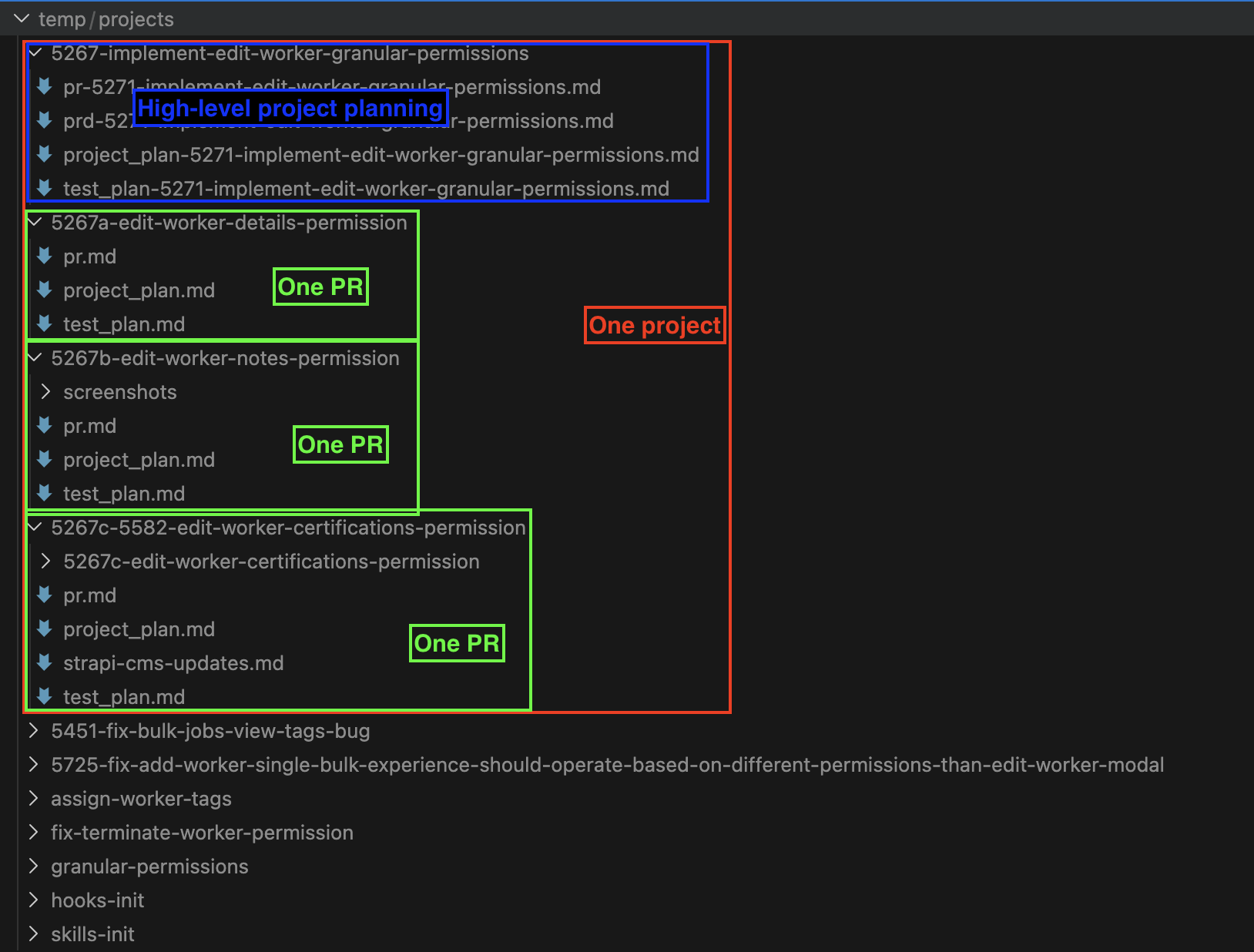
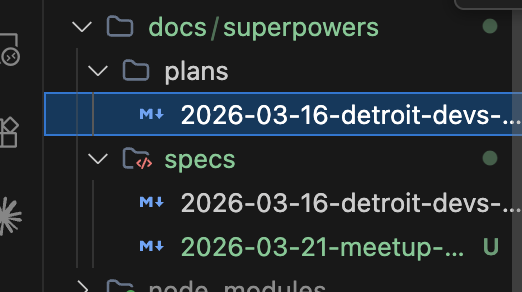
github.com/obra/superpowers
⑂ main
● pilrs-examples.md
25 / 42
Detroit, MI
1234
5678
// context engineering: pilrs in practice (cont.)

⑂ main
● pilrs-examples-2.md
26 / 42
Detroit, MI
1234
5678
// layer 3: harness engineering
Harness Engineering
- Programming around the model - systems that run agents for you
- Multi-step autonomous workflows with human review of outcomes
- Deterministic steps where reasoning isn't needed
- Expands what work gets done at all - not just speed
- Ceiling: ~+10x velocity (S-curve)
⑂ main
● harness-engineering.md
27 / 42
Detroit, MI
1234
5678
// harness engineering: what changes
Prompt & context make your work faster.
Harness expands what work gets done at all.
Harness expands what work gets done at all.
- Every team has a long tail of valuable work that never makes the top of the backlog
- A harness collapses a full ticket - research, implementation, PR - into a parallelizable workflow
- The ceiling isn't +1x or +3x. It's much larger.
⑂ main
● harness-impact.md
28 / 42
Detroit, MI
1234
5678
// case study: odradek
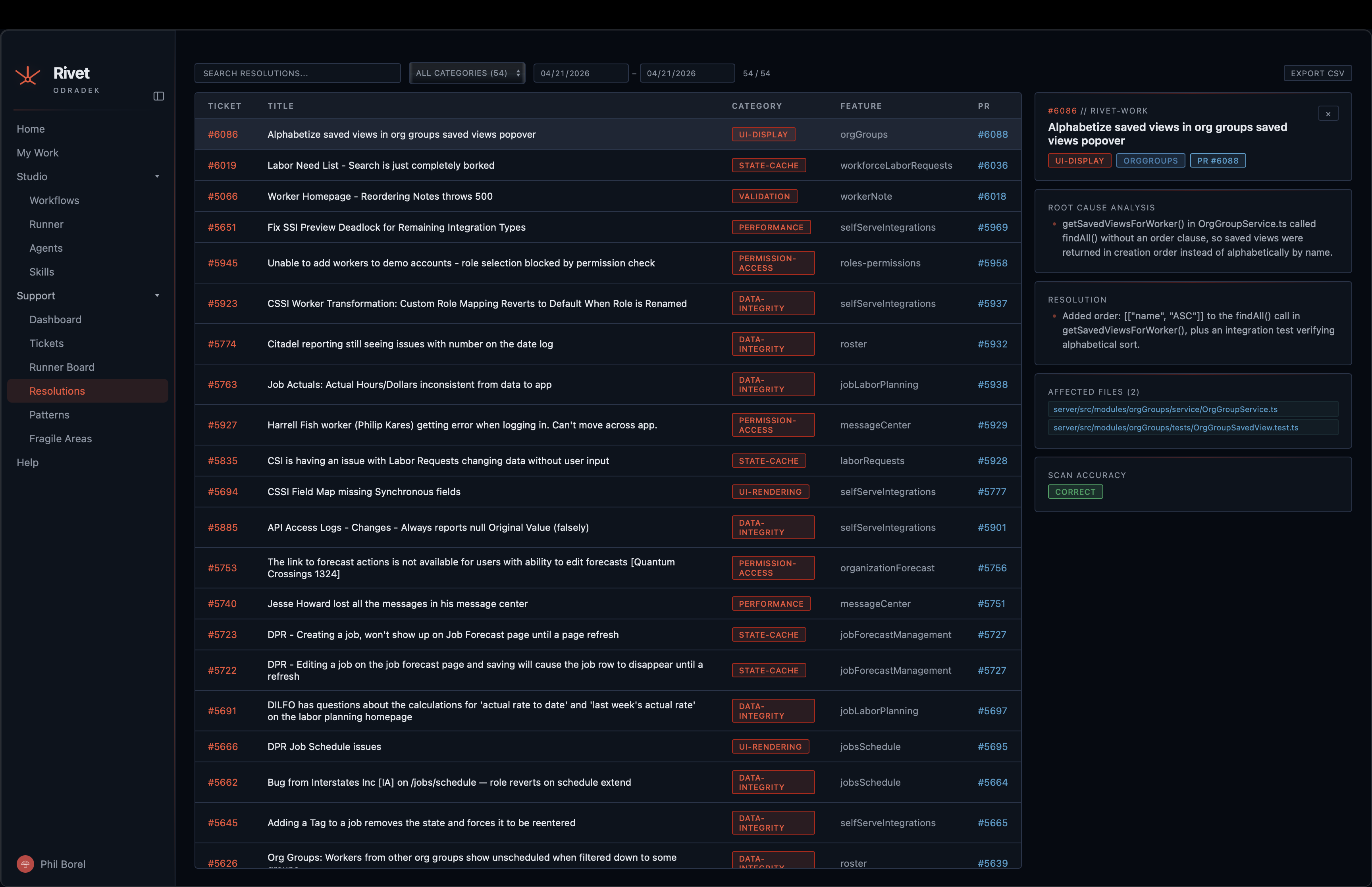
Odradek - Bug Resolution Agent
- Built on the Claude Code SDK - Mac desktop app with cloud-hosted database for multiplayer support
- Investigates - reads source, checks git, consults PILR knowledge base, pulls context from Notion (MCP) & GitHub (CLI)
- Fixes - scoped, surgical edits to the relevant files
- Verifies - regression checks, test additions & CI runs
- Opens a PR - agentic-review phase + human-review phase
- One-shot resolution rate: 80%
⑂ main
● odradek.md
29 / 42
Detroit, MI
1234
5678
// odradek: resolutions view
⑂ main
● odradek-resolutions.md
30 / 42
Detroit, MI
1234
5678
// odradek: the database behind the UI
⑂ main
● odradek-database.md
31 / 42
Detroit, MI
1234
5678
// odradek: impact on the backlog
Odradek impact on the backlog
- P1s (ship-within-a-week): used to sacrifice one engineer per sprint on rotation. Odradek bought back ~half an engineer.
- P2s (fix-within-a-quarter): used to stack for months. Now addressed as they come in.
- P3s (nice-to-fix): were permanent backlog residents. Some are actually getting fixed now.
- Work that would never have happened at the current team size
⑂ main
● odradek-impact.md
32 / 42
Detroit, MI
1234
5678
// odradek: what's next
Odradek Roadmap
- Event-driven triggers - auto-fire on bug ticket creation
- Cloud-hosted dashboard - non-engineers see work in progress & resolution status
- MS Teams integration - ask about bugs & initiate workflows from chat
- Parallel issue processing - git worktrees for concurrent work
- Ephemeral test environments - CS/product verify fixes themselves
- Model routing - right model tier for each task; balances cost & effectiveness
⑂ main
● odradek-roadmap.md
33 / 42
Detroit, MI
1234
5678
// the three ceilings
⑂ main
● velocity-curves.md
34 / 42
Detroit, MI
1234
5678
// RIVET - prompt engineering
Far along, near the ceiling
- Deep investment in CLAUDE.md, rules, skills
- Almost entirely markdown optimization
- Tight feedback loop - edit, run, observe
- Most of the returns are already captured
⑂ main
● rivet-prompt.md
35 / 42
Detroit, MI
1234
5678
// RIVET - context engineering
Early-mid, significant upside
- PILRs pattern is right; infrastructure isn't finished
- Type 1 (Ephemeral) solid, Type 2 (Evergreen) in progress, Type 3 (Cumulative) nascent
- Starting to invest in shared hosting & data infra
⑂ main
● rivet-context.md
36 / 42
Detroit, MI
1234
5678
// RIVET - harness engineering
Very early, asymmetric upside
- Odradek is our first real harness - 80% one-shot rate
- S-curve: slow start, steepest returns ahead
- This is where we're investing
⑂ main
● rivet-harness.md
37 / 42
Detroit, MI
1234
5678
// the takeaway
Unlock Capacity (Eng)
+
Unlock Capability (Product)
+
Unlock Capability (Product)
Capacity
Better prompt & context engineering
makes agentic tools more effective
makes agentic tools more effective
Capability
Designers & PMs prototype,
validate & shape features directly
validate & shape features directly
⑂ main
● takeaway.md
38 / 42
Detroit, MI
1234
5678
// act III take-away
Act III take-away: where to invest your tokens for the most leverage
- Early: Start with prompt engineering. Short feedback loop, transferable skills, necessary foundation
- Mid-stage: Context engineering. Build the knowledge layer. Start with PILRs where agents are most confused
- Advanced: Harness engineering. Pick a narrow, repetitive workflow. Measure the one-shot rate
- The balance: increasing velocity - maintaining quality
⑂ main
● investment.md
39 / 42
Detroit, MI
1234
5678
// close
Next week
- Set a goal: identify an outcome you want & make it a goal
- Focus on fundamentals: prioritizing 1+ tech debt backlog item(s)
- Invest your tokens: focus on prompt, context & harness engineering in that order
- Try Superpowers: github.com/obra/superpowers - it's easy!
- None of this requires a BHAG or an executive mandate
⑂ main
● next-week.md
40 / 42
Detroit, MI
1234
5678
// close
Further reading
- Advanced Agentic Coding & The Journey Towards 3x
- The Three Layers of Agentic Engineering Maturity
- Context Engineering with PILRs
- DORA AI Capabilities Model (2025) · Harness Engineering - OpenAI (Feb 2026)
- CMU Speed at the Cost of Quality (2026) · Are AI Agents Actually Slowing Us Down? - Pragmatic Engineer
- Superpowers plugin for Claude Code: github.com/obra/superpowers
detroitdevelopers.com/blog/agentic-coding-maturity
⑂ main
● resources.md
41 / 42
Detroit, MI
1234
5678
// close
Questions
detroitdevelopers.com
⑂ main
● questions.md
42 / 42
Detroit, MI